This Sunday morning begins with fragile hope. As I make my coffee, I glance out into the garden—dry, mild, quietly inviting beneath a soft quilt of cloud. For a brief moment, the day feels generous, as though it is offering us safe passage. But by the time the mug is empty, the familiar transformation has already taken place. Rain returns, unannounced yet expected, settling back into the land with calm authority. At this time of year, mild air and rain move together, inseparable companions drifting steadily through the season.
Once again, our ambitions of high ridgelines and wide valley views are folded away beneath a grey veil. Rain itself is never the enemy—Carys and I made peace with wet mornings long ago—but the thought of a long drive home, soaked through and heavy with mud, dulls the appeal of distant hills. And so today we choose something quieter. A walk that begins and ends on foot. An adventure measured not in elevation or distance, but in attention.
We set out without a plan, which is often the truest kind of freedom. We begin along the old railway path—a slender ribbon of calm stitched between meadow and woodland. Here, the noise of the town dissolves: engines, urgency, the endless shuffling of people rushing toward invisible destinations. In its place come softer sounds—birdsong drifting through damp air, the whisper of leaves brushing one another, the slow breath of wind threading through bare branches. It feels like stepping sideways out of time, into a gentler rhythm the modern world has forgotten.
At each fork in the trail, I let Carys choose the way. She pauses, glances back, waits for guidance—then understands. Today belongs to instinct. With quiet certainty, she steps forward and takes the lead.
We pass a young oak tree, no more than three metres tall, perfectly formed and standing with quiet resolve. Though winter presses in, it still wears a cloak of pale brown, papery leaves, refusing—for now—to surrender completely to the season. I admire its defiance. There is something deeply human in that resistance, in the refusal to let go before one is ready.
Carys continues ahead, stopping briefly at each junction before choosing the path again. Eventually, she guides us onto a narrow river trail, carved between a steep, rocky hillside and a sloping woodland thick with moss and damp earth. Here, the world feels held—sheltered, enclosed, as though the land itself has drawn us inward. This is the solitude we've been searching for.
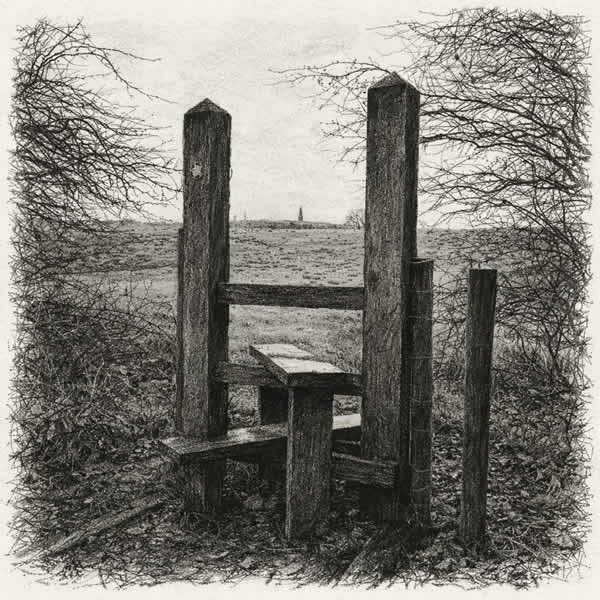
The trail climbs gently through the trees, roots and stones slick beneath our boots. At the top, a stile opens onto a wide meadow, the distant silhouette of Hartshead Pike rising against the low sky. We pause, consider crossing—but something pulls us back. Instead, we turn once more into the trees, descending toward the river, choosing shelter over exposure, intimacy over distance.
High on the hillside across the water, a lone sheep stands motionless, watching us. For a moment, our worlds touch—two lives briefly aligned across space and rain. Then it lowers its head and resumes grazing, unconcerned. We continue on, each returning to our own quiet purpose.
Soon, we arrive at a ruin. Only two walls remain—huge blocks of stone, darkened by age and elements, meeting at a perfect corner. A doorway on one side. A window on the other. The structure is fenced now, guarded by a Coal Authority sign offering a wordless warning of danger. I stand in stillness and try to imagine what once stood whole here. Smoke in the air. Tools resting against the stone. Men moving through the doorway with weary bodies and coal-darkened faces. Lives spent underground, within lamp-lit darkness, backs bent beneath labour that fed the fires of industry and empire.
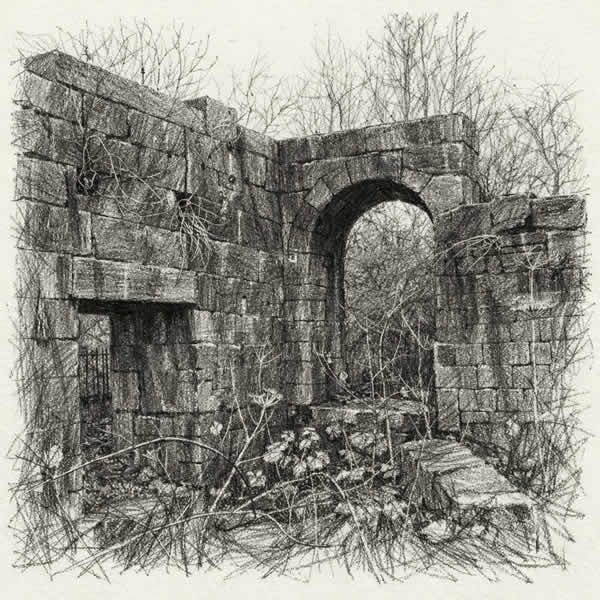
Their voices are long gone, their names forgotten—but I wonder if something of them remains. Pressed into the stone. Anchored in the ground. Places like this feel heavy with memory, as though the land itself remembers what we no longer do. We may abandon our structures, but the earth keeps the imprint of our presence long after we are gone.
We cross a wooden bridge over the river, then another soon after, before climbing onto a bridleway. The silence is suddenly shattered by thunderous hoofbeats—three white horses galloping uphill toward us. Carys drops instantly into a defensive stance, barking her warning. I reassure her, and we take a step back into the trees, giving space, allowing the riders to pass. They nod in thanks, and just as quickly as it arrived, the moment dissolves, and the quiet knits itself back together.
Crossing a narrow lane, we enter a stretch of woodland Carys knows well. She darts ahead now, confident and unburdened. Just beyond, the river bends into a familiar pool, its surface calm despite the rain. She waits at the edge, eyes fixed on mine, until I give the nod. A quick splash—nothing more. Just enough to rinse the mud from her legs, though we both know the effort is temporary.
Recent storms have reshaped the trail here. Fallen trees lie scattered across our path—some sawn cleanly to allow passage, others untouched, forcing us to duck beneath or clamber around. The ground is slick and uncertain, demanding presence with every step. By the time we reach the path back toward Daisy Nook, Carys is once again painted in mud, a moving map of the morning’s journey.
Along the trail, we meet another wanderer. A simple greeting opens into conversation, and for a few unhurried minutes we stand together in the rain, strangers sharing shelter in words. Carys, sensing a connection, drops a stick at his feet. He laughs and throws it for her as we speak. His name is Luke-an Englishman now based in Czechia, and visiting only briefly. We talk about England, the landscapes, the people, the rain, and how he misses our island.
As I listen to him, something settles deep inside me—a truth I’ve always known, quietly reaffirmed. I could never leave this place. While others long for a life of sunshine and distant shores, my heart belongs to windswept hills, rain-soaked meadows, and ancient woodland paths of England. This island holds my soul. It always has.
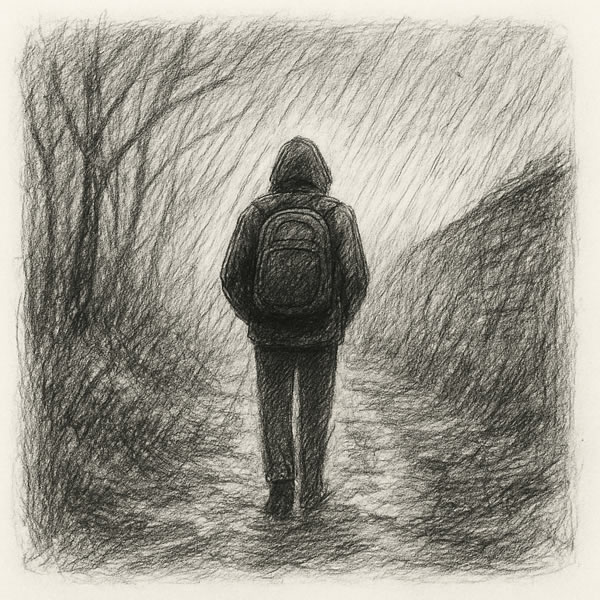
We part company with a handshake. He walks on, coat and backpack dripping, boots heavy with mud—a trophy of dedication, a memory of home for him to take away to distant lands. Encounters like this are rare—rarer than they should be. Two lives briefly intersecting, strangers held together for a moment by shared ground and falling rain.
We finish the morning by the river, where Carys plunges in once more, washing away the mud and restoring her familiar black-and-white coat. The rain continues to fall—patient, indifferent, eternal.
As we turn toward home, I’m reminded that the wild is never empty. Even in its quietest moments, it is layered with presence—those who walked before us, those we meet by chance, and those who will follow long after we are gone. In ruins and river bends, in muddy paths and brief conversations, we are stitched together by shared landscapes and passing moments. We do not walk alone, even when we think we do.
Visitor Comments
"We do not walk alone, even when we think we do."
What a lovely post.Lisa - Chesterfield