Our Sunday adventure begins later than usual today. The week behind us—crowded with routines, early alarms, long hours and late nights—has taken its quiet toll. And so this morning, for once, I gift myself permission to rest. The rare luxury of letting the dawn unfold without me.
When I finally stir, slow and unhurried, Carys sits by my side, watching me with patient expectation. She knows, instinctively, by the clothes I’ve pulled on, that today is a day built for distance—a day measured not by clocks or calendars but by footsteps, open fields and the promise of discovery.
The forecast insists on rain, a relentless grey curtain drawn across the hours ahead. But for now, the sky holds its breath. As we step outside into the fresh morning air, I know with absolute certainty that however clear it is now, we will return wet, muddy, and unbothered by either.
We follow the old railway path, already alive with Sunday motion. Walkers wrapped against the rain, joggers finding rhythm in the damp air, dogs weaving joyful figure-eights around their humans. They greet us with nods and smiles as we pass. Carys, determined today, accepts none of the invitations for attention—she moves forward with a sense of purpose, as though she knows adventure cannot wait.
When we slip into the first open meadow, the world expands around us. Rainwater pools in soft, shimmering patches across the grass—saturated, pliant, not muddy yet, only wet and yielding. The meadow is enormous, a great unwound ribbon of open space. Carys bursts into a sprint the moment we enter, carving wide circles with overflowing joy. Water sprays from her paws in glittering arcs, and each lap she runs feels like pure, unfiltered happiness.
I never grow tired of watching her like this. Her running is not just energy but expression—an outward declaration of life lived fully, moment by moment.
Far ahead, perched high above the valley, stands our destination: Hartshead Pike, its stone tower rising from the hill like a monument to time itself. It watches the landscape with the old patience of things built to outlast generations.
We pass a large farm, its scent unmistakable—the earthy, pungent smell of cattle and straw and early morning labour. Here the fields require careful footing.
Our route winds through a tapestry of fields and meadows, threading between trees and bramble patches. We follow the Tameside Trail for a while, but soon drift away from it, following our own preferences rather than the trail. This is how a familiar landscape becomes eternally new—by allowing ourselves to wander, to step where curiosity pulls us, to move through the world without the fear of losing the path.
A quiet lane guides us onward until a narrow gap in the fence appears—just wide enough for a determined human and a small, eager dog. We squeeze through into another meadow. This one is treacherous: mud thick as clay, deep and sucking.
Carys barrels through with joyful disregard, while I carefully step and weave, trying to avoid sinking ankle-deep into the mire.
The rain finally arrives—not dramatic, but a fine mist that settles over us like breath.
We step beneath a tight, low canopy of trees and emerge into a wild meadow, pure and untamed, its grass deep and lush. The firm ground undulates gently, rising and falling like waves over a green ocean, stirred by an ancient tide.
There, resting on the damp earth before me, lies a small antler—its form smooth yet textured, brown at its roots like turned soil, rising into delicate cream tips. An offering of nature, shed by one of the roe deer that wanders quietly through these meadows.
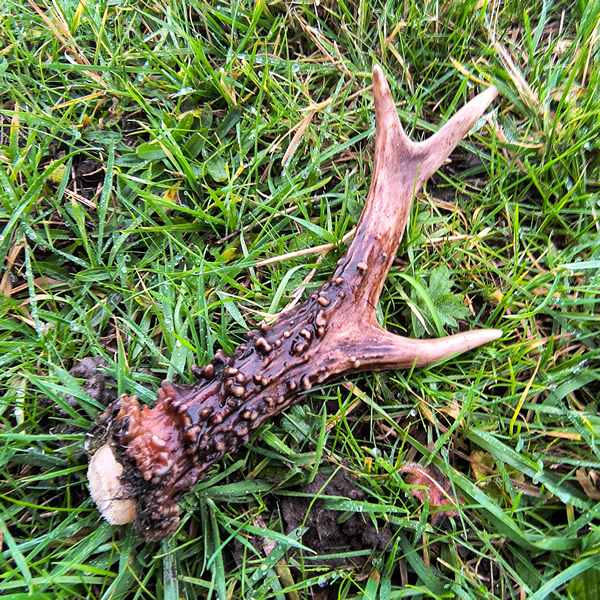
There is something strangely intimate about its presence, as though it had been placed there purposely-a precious gift, especially for me.
I pick it up gently, turning it in my hands before wrapping it carefully and placing it into my pocket, grateful for this precious offering from the wild.
We move through more fields, more meadows—a patchwork stitched together by hedgerows, fences and old stone walls—until we reach the final grassy climb. The ascent to the pike is steep but short and steady, the world around us widening with every step.
At the summit, the wind greets us at once—sharp, whistling, unrestrained. It skims over the hilltop with a kind of wild intelligence, tugging at our clothes, singing through the gaps in the tower’s stonework.
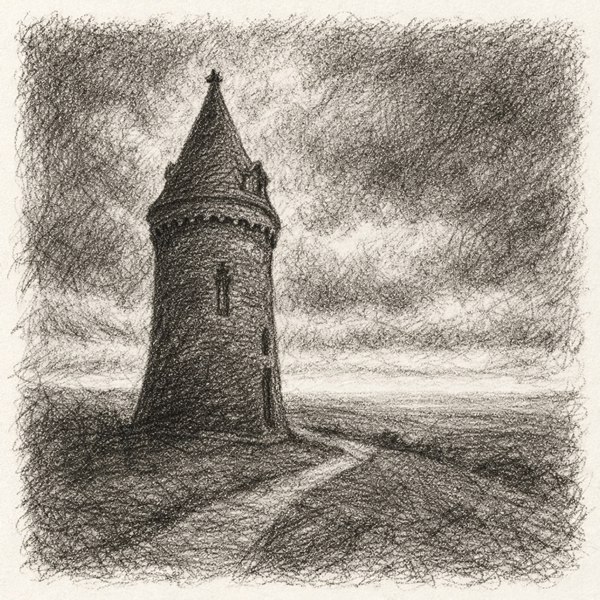
For a few moments, we stand beside the tower, the whole valley stretching out beneath us like a painted map. I imagine people below glancing up toward this landmark, as I now stand beside it, glancing down over the valley. It is comforting, somehow, to be part of a shared story—many lives held beneath the same sky, connected by a single old tower.
With rain silver threads of rain still falling, we begin our descent, slipping between the quiet lanes and open meadows once more. The walk down is easier, quicker, guided by gravity and familiarity.
Eventually, we reach the trail above the woods of Daisy Nook. The steady murmur of the river rises from below, echoing softly through the trees. Beside us, a blue tit calls out from the brambles—a bright flicker of sound in the dim afternoon light. We pause, watching. Then another movement catches my eye: a tiny goldcrest, shy and delicate, emerges from the shadows. It follows the blue tit closely, like a devoted friend. As the blue tit hops, the goldcrest follows. A beautiful companionship-a gentle allegiance, rarely witnessed.
Rain-soaked and mud-streaked, we turn toward home with the promise of a hot bath, dry clothes, and a peaceful Sunday afternoon.
Muddy paws and muddy boots are the small prices we must pay for such adventure. The mud will wash away soon enough, but the memories of the morning and the tiny wonders hidden within an otherwise ordinary Sunday will remain long after.