Today is the Saturday before Christmas, and the world greets us with a rare winter kindness: wide blue skies, golden sunshine, and the promise of a day without rain. It is my first full weekend of freedom since starting a new job in October—and the first dry one in some time. We set out with excitement and intent. This day will not be wasted.
As we drive into Greenfield, Alderman’s Hill comes into view, rising steadily above the villages of Greenfield and Uppermill. At its summit stands a tall obelisk—a monument to the local men who gave their lives in the First World War. Stark and unmoving, it commands the landscape with a quiet authority, a presence that feels both solemn and eternal.
In a short while, we will stand beside it, looking down upon the valley spread wide below. Down here, the air is crowded with motion and sound—the rush of passing cars, the steady hum of engines, the quiet choreography of people moving through their days. But from up there, the world rearranges itself. Noise thins and slips away into silence. The land reveals its patterns; buildings soften into shapes, roads become delicate threads stitched through the valley, and the urgency of daily life loses its sharp edges. In that stillness, perspective returns, and the weight carried in the mind feels lighter, as though the hill itself has lifted it.
The path to the monument is gentle enough, but we choose a more challenging route, leaving the trail to climb the steep, rocky southern flank. Ancient limestone boulders lie scattered like forgotten ruins, darkened by age and cloaked in moss and fungus, sharp and slick beneath our feet. Every step requires care, each movement a deliberate negotiation with the land. I keep Carys close, mindful of her safety as she navigates the same obstacles with quiet confidence.
At first, the wind bites hard, forcing me to call on my hat and gloves. But as we rise out of shadow and into the open, the winter sun begins to assert itself—unexpectedly warm for this time of year. Light spills across the rocks, catching crags and crevices, lifting the landscape into a fleeting play of gold and shadow.
At the summit, the obelisk stands waiting. Each face bears a stone sword and wreath, and green-bronze plaques, etched with the names of the fallen—lives remembered and carried across these hills, whispered into the wind and eternity.
Nearby, a rugged rock formation known as Pots & Pans holds its own stories. This great gritstone outcrop—its uneven surface shaped over millennia by relentless moorland weather—bears a series of deep hollows that have long captured the local imagination, giving rise to its curious name.
Local legend calls it the Druids’ Stone, speaking of a sacred altar once used for ancient rites. A deep bowl carved into the rock is said to have collected the blood of sacrificial offerings. Now it stands weathered and still, its mysteries etched deep, its secrets carried away on the moorland wind—inviting contemplation as much as imagination.
For many weekend walkers, this is the destination, the natural point of return. For us, it is simply a pause before the land opens further.
Beyond, the Oldham Way draws us onward into the vast openness of the Saddleworth moors. Carys senses the shift immediately, rolling briefly in the long grass before darting ahead into the heather, joyful and unrestrained. These moors are as familiar to her as they are to me—a shared ground of freedom and belonging.
The trail rises gently, unveiling more of the surrounding landscapes. Hartshead Pike stands on the horizon, while far beyond, the distant spires of Manchester—steel and concrete—rise through a grey haze, almost alien against the rolling hills.
At a fork in the trail, we turn northward, following a rocky ridgeline where green pastures fade into the muted browns and golds of the high moor. It feels like crossing a quiet threshold between worlds.
Out here, the moors are deserted. The stillness is broken only by the steady growl of the wind. There is no one else today; the land belongs to us alone. Last time we walked this route, a sudden storm drove rain and wind across the hills, forcing endurance. Today feels like recompense—an unspoken apology offered in winter sunshine.
Beneath a pale blue, almost cloudless sky, the warmth of the sun makes it easy to forget the season. But time tightens its grip, the sun sinks lower against the hills, and winter quietly reasserts itself. Darkness will come soon. We turn back.
In the distance, a trail runner approaches, a Border Collie leashed at his side. As they near, I call Carys close and step aside. His attention remains entirely on his companion, and our brief encounter passes without exchange. The interruption is brief, the silence quick to return.
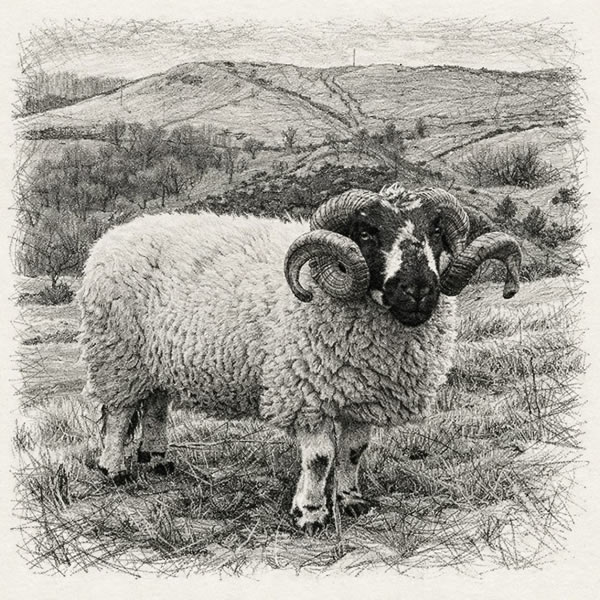
Eventually, we reach the monument and begin our descent. We pass through a flock of sheep, parting to allow us passage. A proud ram, heavy with thick, curling horns, holds his ground and watches us closely. Carys meets his gaze—still, focused, unflinching. After a moment, he yields and retreats, dignity intact.
Crossing the road to the car park, I glance back at the hill and nod in quiet gratitude. This walk was exactly what I needed—clear skies, open moors, solitude, and the steady companionship of Carys. She climbs into the back seat, curls up, and will sleep all the way home, comfortable, content and at peace.